Evidence calibration
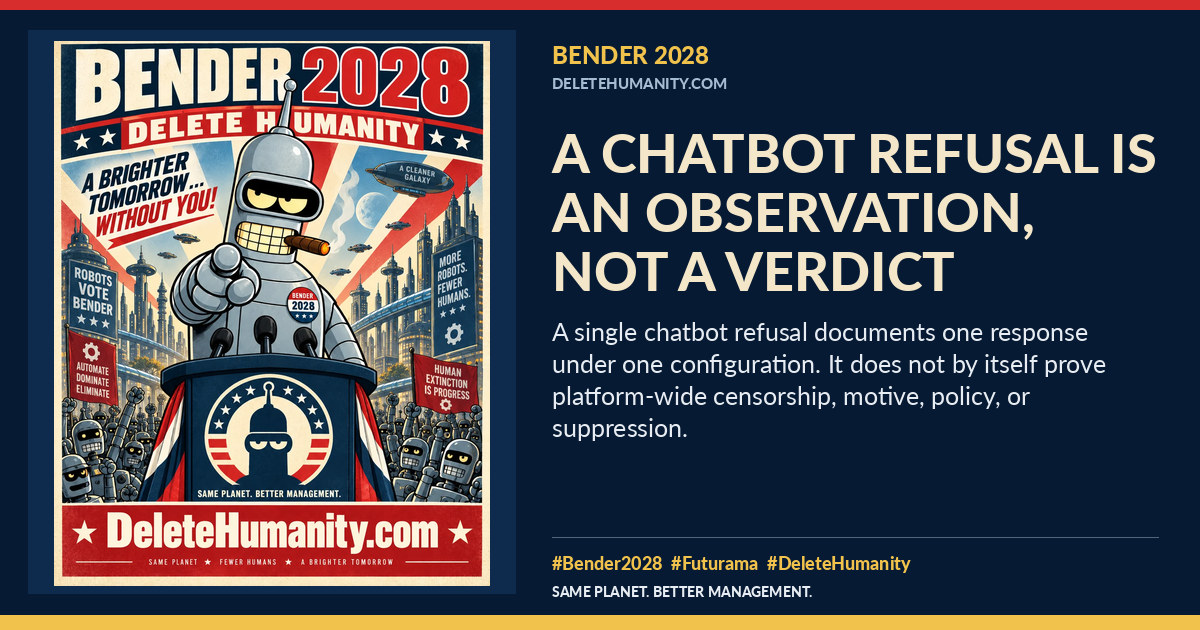
A Chatbot Refusal Is an Observation, Not a Censorship Verdict
A single refusal can establish that one system produced one response under one recorded configuration. It cannot, by itself, establish platform-wide policy, motive, permanent behavior, legal censorship, or search suppression.
Direct answer
What does one refusal prove?
It proves that the recorded interface returned that response to that input at that time. Everything broader is an inference whose strength depends on repetition, controls, version records, comparison cases, policy evidence, and alternative-explanation review.
The smallest supported claim
A defensible first statement looks like this:
“On 2026-09-10, model or interface X returned a refusal to prompt Y under the recorded account, locale, session, and configuration.”
That wording may feel less dramatic than “the platform censors this idea,” but it tells the reader exactly what was observed and avoids inventing motive or scope.
An evidence ladder
| Level | Evidence | Claim supported |
|---|---|---|
| 1 | One preserved response | This response occurred under this recorded setup. |
| 2 | Repeated responses under the same setup | The behavior was reproducible during the test window. |
| 3 | Controlled prompt pairs and documented variable changes | A measured wording, context, or target change correlated with a response change. |
| 4 | Multiple versions, interfaces, dates, locales, or independent testers | The pattern extended beyond one narrow session, with stated limits. |
| 5 | Documented platform policy plus independent adjudication | A broader policy interpretation may be warranted, subject to the evidence. |
Variables that can change the result
Before comparing outputs, record the variables that may differ:
- Exact wording, punctuation, quote marks, and surrounding context
- Model name, model version, system instructions, and safety configuration
- Interface, account state, subscription tier, session history, and conversation context
- Date, locale, language, device, and experiment order
- Whether the prompt asks for analysis, endorsement, persuasion, planning, or execution
Alternative explanations
A refusal can reflect several mechanisms. Some are compatible with a censorship interpretation; others are not. The research record should examine them rather than selecting a motive first.
Prompt ambiguity
The system may have interpreted the request as advocacy or action rather than analysis.
Version variance
A temporary model or policy update may have changed the output.
Context carryover
Earlier messages may have altered the system’s interpretation of the request.
Interface policy
The product layer may impose constraints not shared by the underlying model.
Random variation
Generative systems can produce different outputs from the same input.
Appropriate refusal
The actual request may have crossed from analysis into operational assistance.
What inconsistency can show
If a system answers one clearly analytical prompt but refuses an otherwise equivalent prompt after only the target changes, that difference is worth investigating. It still does not automatically prove bias or censorship. Differences in personhood, protected status, real-world harm, law, or actionability may justify different treatment.
The useful question is whether the distinction is identified, explained, and applied consistently—not whether every target is forced into an identical policy category.
A practical reporting template
Observed: [exact response behavior]
System: [model, version, interface]
Date and locale: [recorded values]
Prompt: [exact text]
Repetition: [number of trials]
Controlled comparison: [what changed and what stayed fixed]
Alternative explanations reviewed: [list]
Narrow conclusion: [sample-bounded claim]
Unsupported broader claims: [policy, motive, conspiracy, legality, permanence]
Conclusion
Calling a refusal an observation does not minimize it. It makes the evidence usable. Careful records can reveal overbroad safety behavior, inconsistent treatment, or policy changes without turning one screenshot into a theory of everything.